Thursday, March 27, 2014

DBQ "Mini Q" Valley Forge

DBQ...Document-Based Questions.  I was trained on this over the course of the last year and have done two DBQ lessons.  One was on Jamestown (Early Jamestown: Why did so many die?) and this last one on Valley Forge (Valley Forge: Would you have quit?).  My fifth graders LOVE doing DBQ lessons.

There are 7 components of a DBQ unit:
1. The Hook: getting students to think about the topic
2. Background Essay: providing context and a purpose for learning
3. Pre-bucketing: organizing thoughts
4. Document Analysis: carefully examining documents (primary and secondary sources)
5. Bucketing/Chicken foot: deciding on main points and which documents support them
6. Thrash out: students are discussing the evidence found on each document and how it supports arguments
7. The Essay: a 5-paragraph essay, from graphic organizer to final copy

I do the hook, background essay and pre-bucketing with the whole class.  The students lead the discussions though and I guide when needed.  We do the first document together as well.  I like to set the tone here. The documents are charts, graphs, pictures, journal entries, excerpts from books or articles.  I thought my students might have difficulties locating the evidence in the documents.  Nope.  They are great detectives! I send the other documents home as homework and we discuss/analyze them in class the next day.  The copies of the documents are littered with their notes and questions and highlighting. There are questions to answer on the bottom of the page.  Text-dependent questions.  Another buzzword in education these days.  TDQs. The students must use the documents to answer questions (it's the evidence!).  Doesn't that just scream Common Core?!

After the document analysis, the class gets together to discuss the question and the categories that the documents create. For Valley Forge, our buckets were survival, Congressional support, and not wanting to be a "summer soldier."  The students decided which document supported each category. There were only four documents in this mini DBQ, but two of the documents were contested about how they supported a claim, so it was a good conversation.

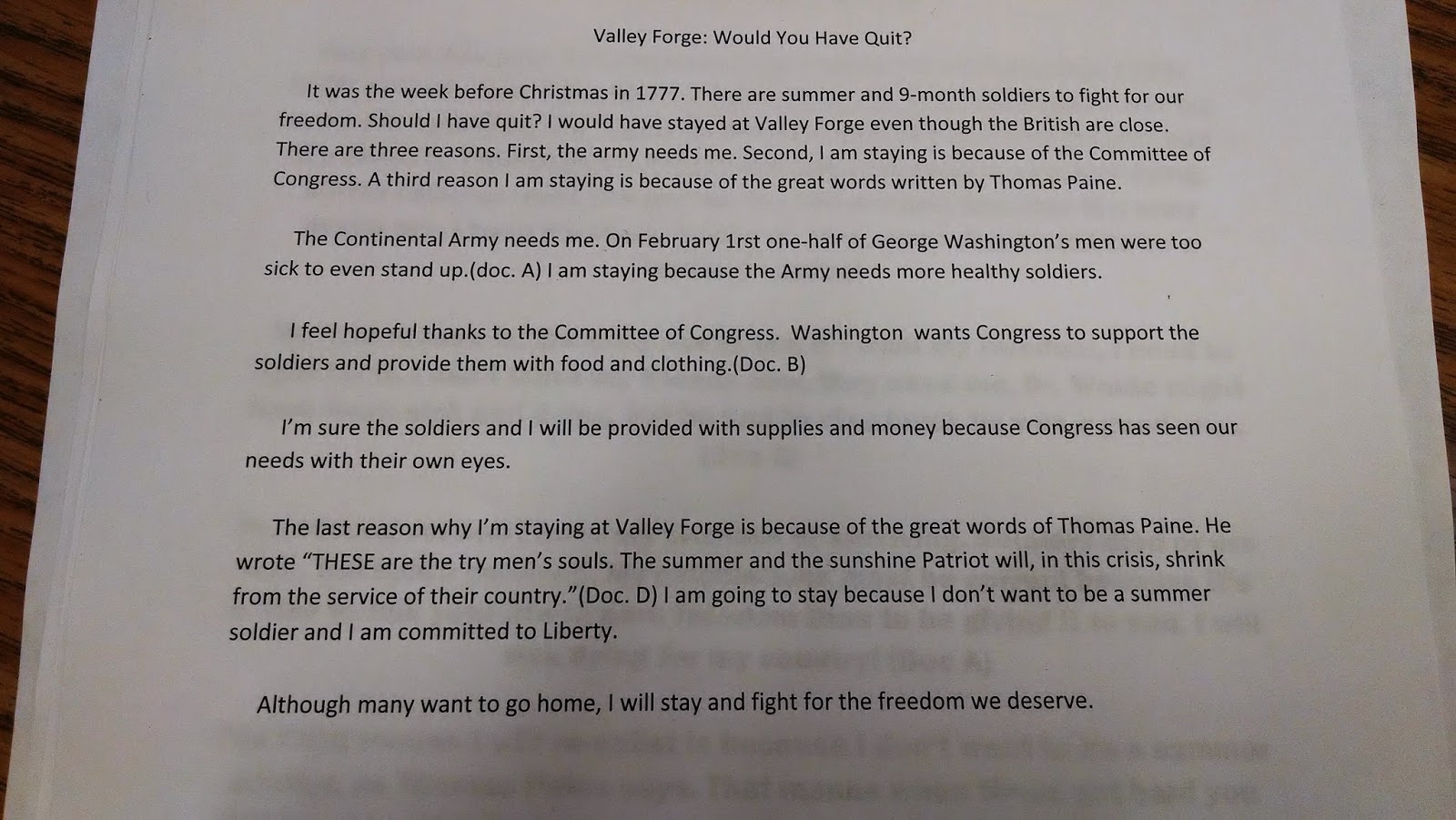
Once we had our documents categorized, the students went through a graphic organizer with sentence starters that set them up to write their 5-paragraph essay.  I was so impressed with their writing!  They were impressed with their own writing!  Check out the website of the DBQ Project and be amazed.  Below are some photos of my students's essays.


Tuesday, January 21, 2014

The King's M&Ms

I was reading a blogger's Facebook page and saw that another teacher posted about The King's M&Ms and encouraged fifth grade teachers to Google it.  So I did.  Wow!  We had fun, fun, fun!!

Right when we came back from Winter Break, I had put my students into groups: England, New England Colonists, Middle Colonists, and Southern Colonists.  In my previous post, I was fomenting war in my room.  Then after lunch, they walked into a classroom that had 10 M&Ms in a coffee filter on each desk, and a set (non-latex) gloves on each tax collector's desk. Each member of Parliament, the Prime Minister, and King George III had index cards with dialogue on them.  They got up and spoke their lines about budgeting and how the French and Indian War had drained their accounts.  The PM suggested that they tax the colonists.


After that, the tax collectors stood up and addressed the colonists.  They read from cards and then went around and collected taxes.


The colonists played along and were properly outraged that they had to pay so much money.  After the King had his 40% and the PM had her 30%, and Parliament split their 20%, and the Tax Collectors got their 10%, I asked the students to write about their experiences as a colonist or an Englishman. While they were writing, I evened out the "income" so all students got a handful of M&Ms in their coffee filter.

Saturday, January 11, 2014

Prelude to War

Oh my stars we are having fun this year in preparation for learning about the American Revolution!  I put my students into four groups: England (King George III, 3 members of Parliament, the Prime Minister, and 3 tax collectors), the New England Colonies (6 colonists), the Middle Colonies (6 colonists), and the Southern Colonies (6 colonists). I allowed England to decide who gets to leave for recess and lunch early.  They, of course, always choose themselves.

Three days ago two of my students were overheard debating whether England had the right to tax the colonists.  After school.  Yes, after school they were debating.  I LOVE THIS!!!

Yesterday after "England" left for recess early, one of my students said, "Mrs. Mitchell, in Social Studies, do the colonists ever do something?" I told her we'd have to wait to read about it, but I asked them how they were feeling about getting left behind.  They were good and mad.  So I asked them what they were going to do about it.  One of my boys wanted to declare war.  (I did tell him it was a bit early in the game)  One of the girls said she'd seen people holding signs and protesting and marching.  I gave her and two other students blank white paper and markers and permission to hide in the library to create signs.  I did not advise them on what to put on the signs.  The other students decided that they were going to block the door so that England could not leave early again.

The unfinished posters:


So at 12:15 I asked England what they wanted to do.  They decided to leave early.  The "colonists" jumped up, blocked the door and held up their signs.  Oh it was a great moment in history!!  I love that the students are coming up with these things themselves.  All I do is stir the pot! So, of course, I asked England what they were going to do about the colonists.  <twirling my dastardly mustache with glee>

On Monday we are going to do my own variation on the King's M&Ms.  Each colonists gets 10 or so M&Ms. The tax collectors will have gloves and will be the only ones to handle M&Ms!  I will give each colonists and Englishmen a coffee filter as a "wallet" for their "money" because I am not into activities that require massive amounts of prep! I have cards that I will give to my Parliament members: jewelry tax, jeans tax, sneakers tax, electronics tax, and something else.  Each tax is worth 2-3 M&Ms.  Members of Parliament, the Prime Minister, and King George III have speaking parts (on index cards) where I've taken information from our text books and made little snippets of dialogue. Then we'll really be ready for a revolution in our classroom!  

Friday, December 6, 2013

Striving for Creativity in the Common Core

I love foldables.  There.  I said it.  Last year my students called me The Foldable Queen and even referred to me as Your Majesty. I sure do miss that group of kids!  I had math down pat with foldables, ISNs, etc.  This year, we have a new program for math.  I'm excited about it because it addresses the new CCSS, but it doesn't leave much time for foldables or other engaging activities. My foldables aren't a daily thing anymore, but more as a way to kick off a chapter and/or to wrap up a chapter. We do refer back to them frequently and I allow students to use them during quizzes or tests. It's a great way to ensure they take good notes! The pictures are from the notes we took at the beginning of the chapter.  The foldable is part of a math pack I got from Jennifer Runde that has been a God-send!!


Sometimes one can get a class that can't work in groups if their lives depended on it.  This year I have such a group.One of the standards/practices that "they" want kids to do now is to work collaboratively. The only way I can do this with this group of kids is to have them on a very short time limit when I place them in pairs or triads. Today we were multiplying with money. They were asked to identify what they had to solve, then the information they needed to get that solution.  Then they had to set up the problem using a diagram. We did one together and I had them do one in a triad.  I gave them 7 minutes.


It was rather successful.  Today.  I miss doing a foldable or graphic every day in math.  The new math program, Go Math by Houghton Mifflin Harcourt, has everything all laid out and is on two double-sided pages for each lesson.  But I miss drawing and coloring and cutting and gluing in math.  I'm working on getting back to that comfortable place.  During the first year of an adoption, it's hard to know when to stay and when to stray.

Wednesday, December 4, 2013

Making the Common Core fit with pre-CCSS curriculum: Literature

Making the CCSS fit with seriously outdated curriculum can be incredibly challenging!  I read a lot, follow teacher blogs, and get great ideas from fantastic educators on Pinterest.  My district has fully embraced the CCSS and has provided a lot of professional development opportunities.  My principal has also provided us with PD hours to do book studies using books that are fresh and current in education. Having said that though, our ELA curriculum is 14 years old.  Yikes!!! There are some great stories in there, but... It takes some time to create lessons using the CCSS.  

I mostly teach novels, but sometimes I use our old Open Court anthology selections.  Two weeks ago I used Love as Strong as Ginger.  It's a cute story about a girl who spends Saturdays with her Grandmother.  There is a LOT of figurative language!!  I made flip books for figurative language notes which were glued into our ELA journals. I printed out two poems by William Carlos Williams to use to introduce the topics of mood, tone, and imagery.  We read only two-three pages each day and practiced close-reading strategies, using ou journals to take notes. It was a smash hit with the students.  To have them so excited about an anthology story is rather rare!  


We highlighted words that helped us with tone, mood, and imagery.  Then we drew what image came to mind.  


 I really wanted the students to feel comfortable using words like tone, mood, and imagery.  I provided sentence frames for the students to glue into their journals in addition to the 8.5x11 size I put up on the wall. We used them over and over and over that week.  As part of the frame, I had them citing evidence each and every time they made a claim about any of those literary elements.  I hear "I know this because..." a lot now, no matter what we are reading.

The students were able to pick out a lot of figurative language on their own.  They were like language detectives!  

We hit four standards with one story.  I did not teach it the "Open Court" way, but planned my lessons the "CCSS" way and used an Open Court story.  

Key Ideas and Details

  • CCSS.ELA-Literacy.RL.5.1 Quote accurately from a text when explaining what the text says explicitly and when drawing inferences from the text.
  • CCSS.ELA-Literacy.RL.5.2 Determine a theme of a story, drama, or poem from details in the text, including how characters in a story or drama respond to challenges or how the speaker in a poem reflects upon a topic; summarize the text.

Craft and Structure

  • CCSS.ELA-Literacy.RL.5.4 Determine the meaning of words and phrases as they are used in a text, including figurative language such as metaphors and similes.

Integration of Knowledge and Ideas

  • CCSS.ELA-Literacy.RL.5.7 Analyze how visual and multimedia elements contribute to the meaning, tone, or beauty of a text (e.g., graphic novel, multimedia presentation of fiction, folktale, myth, poem).

Making the Common Core fit with pre-CCSS curriculum: Informational Text

I've been reading about so many people who absolutely hate the new Common Core standards. It makes me wonder what are they seeing that I am not.  Is it a lack of training from the district/administrative level?  Is it a lack of materials that match the standards?  Perhaps I am in a district with an abundance of support.  I have enjoyed learning the new standards.  It's been fun for me to find new ways to deliver the same old curriculum. 

Below are some pictures from a lesson I did on water directly from our Science text.  The students enjoyed the "coloring" and recreating the graphics the authors used while taking notes in our foldable.  Note, the graphics are directly from the text books.  

Our Science chapter was called The Water Cycle.  I took a 12x18 sheet of white paper and did the shutter fold, then cut the "windows" so that I would have four. We labeled them for each subsection in the lesson.


From the Common Core State Standards:

Key Ideas and Details

  • CCSS.ELA-Literacy.RI.5.1 Quote accurately from a text when explaining what the text says explicitly and when drawing inferences from the text.
  • CCSS.ELA-Literacy.RI.5.2 Determine two or more main ideas of a text and explain how they are supported by key details; summarize the text.
  • Craft and Structure

    • CCSS.ELA-Literacy.RI.5.4 Determine the meaning of general academic and domain-specific words and phrases in a text relevant to a grade 5 topic or subject area.
    • CCSS.ELA-Literacy.RI.5.5 Compare and contrast the overall structure (e.g., chronology, comparison, cause/effect, problem/solution) of events, ideas, concepts, or information in two or more texts.

We quoted from the text, we determined the main ideas of each subsection, and we summarized.  In addition, we worked with domain-specific words and worked with the structures the authors used to deliver the information to us.  I used the CCSS when planning the delivery of this lesson.  Science is pretty easy to fit into the new standards.  I'll do the same in the next post with our very outdated Open Court story.  


 I LOVED this idea from Runde's Room using this block number to limit the students to the number of words used in the summary.  We did this for the first subsection of The Water Cycle lesson.  It really held them down to key details and they could not include too many details.  


Tuesday, February 12, 2013

GCF, LCM, eieio!

Oh fractions.  Who doesn't love teaching them?!  It is probably one of the most difficult units in Math.  A teacher used a block letter F to show GCF and a block letter M to show LCM.  So simple, so absolutely fantastic!  These two lessons were not confusing at all.

I used Microsoft Word and typed (in 250 font) an F and then went to "font" and clicked on "outline" to get a block letter.  I made them large enough that I got 4 on a page.  I ran them off back to back so that the students had 8.  I did the same for the letter M.

GCF:
I started off my lesson with a quick reminder that factor + factor = product.  Then we looked at the multiplication chart on the wall and just called out factors of a given number.  Then I passed out the page with the block letters. At the bottom of the F, write down a number.  Then in the upper parts of the F, write out the factors.  The teacher who originally did this used an arrow to link the two lines.  The class and I did the front side together, they did the back side in partners.  We did the guided practice problems in our book together. When it came time for independent practice, they were ready.


LCM:
I did Jennifer Runde's math journal page with the "egg-cellent multiples" and reminded the students that multiples are skip counting.  We discussed how the GCF is finding factors that numbers have in common, and the LCM is finding the products that numbers have in common.  Our next activity was to take term LCM and do the Frayer Model and really get what the term means and what it looks like. I also lifted this from another teacher (not sure who it was though, will come back and tag when I locate). Then we did the block M page.  Again, 4 on the front, 4 on the back, 4 together, 4 in partners.  As with the GCF lesson, the LCM lesson took a couple of days and lots of practice. Using the block letters and all the journaling really helped the students understand each term and they could apply it without mixing the two.


Saturday, January 19, 2013

Snowflakes and Decimals

We are on a modified traditional schedule.  This means that I am off from the Friday before Thanksgiving to the first regular day after New Year's Day.  I no longer do any holiday art.  I am also in California which means we don't know the first thing about the snow aspect of winter.  Because I sort of miss creating holiday art, I consoled myself with snowflakes yesterday.  I saw the snowflakes from Mor at A Teacher's Treasure and loved them!  My students enjoyed them yesterday too.  Because they were a bit more involved than I gave them time for, we'll be enjoying them on Tuesday morning as well!


 So, on to decimals.  This is totally a thank you post to Jennifer Runde.  Her awesome interactive math journal is well worth the investment.  The more I use foldables and journaling in math, the better my students get at producing and understanding.  We're finishing up with multiplying with decimals and heading to dividing with decimals.  Usually this worries me, and sets me up to be frantic during fractions, but I am not anxious at all this year.  We review every day.  We journal every day.  We refer to our foldable every day.  The students know what to do every day.  Easy peasy. 

On Mondays and Wednesday I introduce new lessons.  We do our journals and a foldable (if applicable) or a table or some graphic.  Then we do some practicing together.  After that, my students work independently for awhile, then work together to review their work and discuss mistakes.  On Tuesdays and Thursdays, we review the previous lesson and do a few more problems together, then the students continue to practice.  

As always, they do Calendar Math from Stephanie Moorman which gives them continued opportunities to practice place value, fractions, decimals, mean/median/mode, and operations.  Again, well worth the small investment.  The returns are priceless. 


Thursday, October 11, 2012

Math - Exponents

We did Exponents today and it was a fabulous lesson.  It was one of the those lessons where everything fell into place.  I typed in "exponents" into the search bar on Pinterest and found a foldable with a sentence strip and some candy corn! The sentence strip foldable is from To the Square Inch and it was a huge hit with the students.

I asked them to fold it into 8 parts, then asked them to write two to the 6th power and then had them fill out the rest of the "boxes" created by the folds.  I did not have them fill out the last one, the answer.  I had them go back and write out the standard and then we wrote the objective and highlighted the appropriate words: repeated multiplication.  Then I asked them to figure out the answer to the sentence strip problem.


Sorry it is sideways.  I cannot figure out how some pictures turn over and some stay upright. 

After we glued our sentence strips into our journals, I handed out the candy corn blacklines to the students.  I found this on TpT via Pinterest (Stacy DiNello).  I made the definition fit my needs, but it was a great idea!
I walked the students through the definition.  Then we labeled the parts (base, exponents), reviewed the key idea: *repeated multiplication* and I asked the students to solve 4 to the 3rd power.  A few of my math whiz kids got this immediately.


Then we paused to color.  Coloring is important.  *I* find it incredibly relaxing!  The students appreciate the brain break. Please excuse my messy coloring!  I did some guided practice.  Under some of the problems, I wrote in words what the numbers were saying so the students could more easily follow along.  It was at this time that I reminded them that 4 to the 3rd power could also be identified as 4 cubed.  I showed them the 10s trick that the number of zeros was the same as the exponent number.  After we walked through 8 guided practice problems, I gave them my ticket out the door paper and had them solve two exponent problems. It was very enlightening! 19 students did this easily.  Five students were able to write the exponents, but did not do repeated multiplication.  Instead they multiplied the base by the exponent. Two students were just completely lost.  So, tomorrow, I have two small groups to work with while my other students do the independent practice on their own.  I was very pleased with the lesson outcome today.


And then do you know what happened later this morning?  My district blocked Pinterest!  Hmphf.  Now I have to email our Tech Support and ask them to unblock it. 

Sunday, October 7, 2012

Class Elections and Cootie Catchers

CLASS ELECTION
We have not had a Student Council in a few years.  This year we've got one again.  Our election in our class was so awesome for me.  This past week was not one of the best.  Lots of deadlines all in the same week.  Such fun! I squeezed in nominations, campaigning, and the election into an already crammed week.  As you know, when you cram things in, they are not done with justice.  Except this time, these children stepped up on their own.  It was a sweet thing to watch.  I walked through the the nomination process of nominating, seconding, etc.  We got ten candidates.  I allowed the ones who did not want to run to bow out of the race.  We ended up with six candidates.

On their own, they made posters and campaigned.  It was so cute!!  I was amazed.  The candidates made their promises and told why they'd be the best representatives for the class.  One girl (one of the two eventually elected) said she would make a great representative because she had a lot of school spirit and showed it.  Yes she does.  Our election coincided with mustache day and she was sporting a walrus mustache while wearing a school t-shirt.

When it was time for elections, I was just going to pass out ballots.  The students were having none of that.  They wanted voting booths.  They wanted pomp and circumstance!  I dug out my homemade privacy shields, got a box for dropping in ballots, and started calling students back to the voting area. They had a blast.  I had a blast watching them.  Then I tallied up the votes and we had two new representatives!


COOTIE CATCHERS
I was reading on Runde's Room about how she uses cootie catchers.  I love cootie catchers!  I marked off the lines, added in the information I wanted them to focus on, and used them for a math review for the chapter test.  The kids were really engaged in the review!  I gave them a sheet for figuring and writing down answers, and they used a clipboard--but not text books or math journals.  I told them they had to answer all eight questions.  They moved around the room and worked with a partner.  I think I will use them as a review for Science as well.  The possibilities are endless.  As a result of the math journals and the review, for the first time ever, my students did well on the Place Value chapter!  Yay!!


Monday, September 10, 2012

A New School Year

In case I haven't mentioned it yet, I teach at a Title 1 school.  Our kids are disadvantaged SES, ELLs, and maybe a few other TLAs (three-letter acroynms).  They are awesome, they try hard all the time, they make me laugh and help me enjoy my job.  This group has a lot of holes, but they are interested in what we are doing every day.  They love to participate and do so thoughtfully.  I write this because it's going to seem like the writing in my picture (my writing) is way too simplistic given that I teach 5th grade.  I just have to start slow and build.

Now about our new year.  For ELA I made folders I found on Pinterest.  You take a two pocket folder with the three prongs in the center.  Then you take another two-pocket folder (no prongs) and turn it inside out.  Trim the top about 1/4" or so, and three hole punch it on the loose end.  Put it in the first pocket folder and secure it with the prongs.  Voila!  Four pocket folder.  In the front two pockets, I put our Reading stuff...foldables, weekly vocabulary work, and other papers that they'll keep (character trait list, comprehension strategies, etc.) for the year.  The back two pockets are for Writing.  Again, foldables go on one side, and their resources and drafts go in the other.  It's working out very well so far.  No lost papers.


Math is a HUGE change for me this year.  I've taken ideas from many people and created a new way to deliver math this year.  It is going VERY well so far.  From Runde's Room  I am doing math journals.  The kids love this!!  We do the lesson on the left side and practice/proof on the right.  We're writing standards and objectives and highlighting and doing vocabulary and foldables and and and!  The kids are obviously not the only ones who love this.  Instead of doing a lesson a day, we've gone through our book and eliminated lessons that are not on grade level or don't assist the students in mastering the standards.  So I am doing the good lessons for two days.  It's very freeing to give up that program imposed timeline.  Day one is all about the lesson, examples, and guided practice.  And of course, opportunities for me to check for understanding.


On Day 2 I have taken Working 4 the Classroom's Math Matters method of independent practice and applied it to my room.  The students sit on the floor, back-to-back, and do their work silently.  When they are ready, they turn and sit knee-to-knee and correct their papers together.  Then we come back together and I have a little session of check for understanding.  This part of my lesson has never gone so well.  The students are not struggling so much.  They are thinking about their mistakes and discussing them. There is just a ton of time for us to practice, practice, practice.  IMO, this is seriously lacking in current adopted Math programs.  But this is a happy post, so I'm not going there.

On Fridays I'm spending a large amount of time doing math workshop so I can target each student and work to get them up to grade level.  While I'm working with a group, they are working on extending lessons, multiplication practice, and calendar math that I got from Stephanie R at Teaching in Room 6.  It is fabulous! This really gives the students consistent practice with numbers and concepts.


Science...LOTS of foldables.  LOTS.  I bought my students colored pencils this year instead of crayons.  They are doing diagrams and labeling parts of plants and coloring things.  Very cool.  We did Vascular Plants last week.  We did a three-flap foldable with root/shoot systems at the top, classification of vascular plants (spores, seeds: flowers/no flowers) in the middle, and parts/purpose of the flower in the bottom.  On one of the days of this lesson a student said, "We're doing Science, but it's like Art!"  They are so excited to do Science!!


Social Studies.  Just a repeat of Science.  Lots of foldables.  When we get to the Colonial period and the American Revolution, we'll start creating books as well as doing fun projects like stick figures in history and fake Facebook pages for our Founding Fathers.  Lots of writing opportunities there as well.  This is my favorite subject, but I seem to be focusing more on my less favorite subjects.  I guess I'm still trying to find my balance.


I won't be so picture heavy again!  One subject at a time!